Europe’s strategic autonomy, Central Europe’s strategic dependence?
Political risks of Europe’s emerging defense industry.

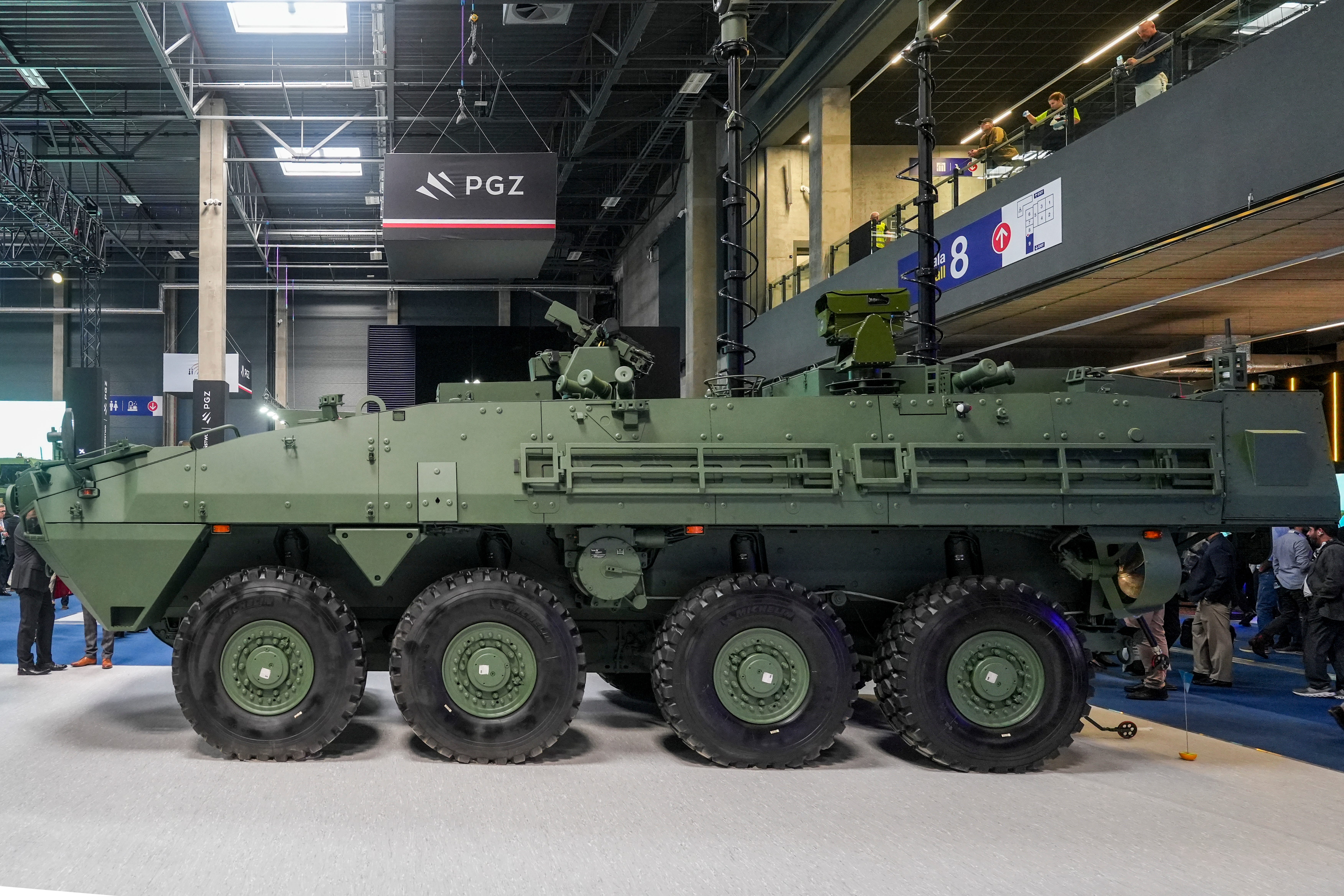
An armored vehicle displayed by Poland's PGZ at MSPO 2026 in Kielce. Photo: Krzysztof Popławski / Wikimedia Commons / CC BY 4.0.
Data from the Stockholm International Peace Research Institute (SIPRI) indicates that Russia’s war against Ukraine has triggered unprecedented growth in the European defense industry. In 2024, the combined arms revenues of European companies in the SIPRI Top 100 rose 13% to USD 151 billion. Of the 26 European companies in the ranking, 23 increased their arms revenues, while most also expanded production capacity in response to growing demand from the war in Ukraine and rising defense spending across Europe. At the same time, the ranking’s structure shows that the benefits of this boom have been distributed unevenly. Western European companies such as BAE Systems (fourth globally), Leonardo (12th), Airbus (13th), Thales (15th), and Rheinmetall (20th) continue to lead among European arms producers. These firms control the most advanced segments of Europe’s defense industry, including aerospace, missile, electronic, and land-system technologies.
The defense industry differs from most economic sectors in that the boundary between commercial activity and national security is exceptionally thin. Decisions concerning corporate ownership, technology, public procurement and supply-chain organization are not merely economic decisions. They can directly affect a state’s ability to conduct security policy and, in turn, its political and strategic position. From this perspective, Europe’s defense industry expansion should be analyzed not only as industrialization or increased production capacity. It is also a redistribution of control over strategic assets. The question of who manufactures weapons is therefore less important than who controls the technology, ownership, know-how, supply chain, and decisions about further product development.
The SIPRI ranking provides the first clear signs of the growing importance of certain Central and Eastern European companies. The most striking example is the Czech Czechoslovak Group (CSG), which climbed from 81st to 46th place in the global ranking and increased its arms revenues by 193%—the highest growth rate among all companies included. According to SIPRI, more than half of the company’s revenue came from implementing the Czech Ammunition Initiative in support of Ukraine. Meanwhile, Polska Grupa Zbrojeniowa (PGZ) rose to 51st place, increasing its revenues by 34% to USD 3.04 billion. This does not, however, amount to a fundamental change in the structure of the European defense industry. Both CSG and PGZ remain medium-sized companies compared with Western European groups whose revenues are between two and as much as ten times higher. Although the war has created conditions for the rapid expansion of some Central and Eastern European firms, the most advanced technological capabilities, the ability to integrate major armament programs, and control over European value chains remain concentrated in the core countries of European integration.
This is where political risk comes in.
In its conventional definition, political risk encompasses, among other things, changes resulting from government policy, international conflicts, sanctions, breaches of contract, expropriation, discrimination against or preferential treatment of particular actors, and changes in how markets operate. In the defense industry, these categories do not disappear. On the contrary, they take on particular importance because the state is itself one of the market’s principal customers, regulators, and participants. The first dimension of risk concerns corporate ownership. In the civilian sector, a foreign owner may primarily be an investor providing capital, technology and access to markets. In the defense sector, foreign ownership can have far greater implications. Ownership may bring control over investment decisions, technology, research and development, intellectual property rights and supplier selection. A foreign investment can therefore strengthen domestic production capacity while also creating a new kind of dependency.
The mechanism can be illustrated in simplified form:
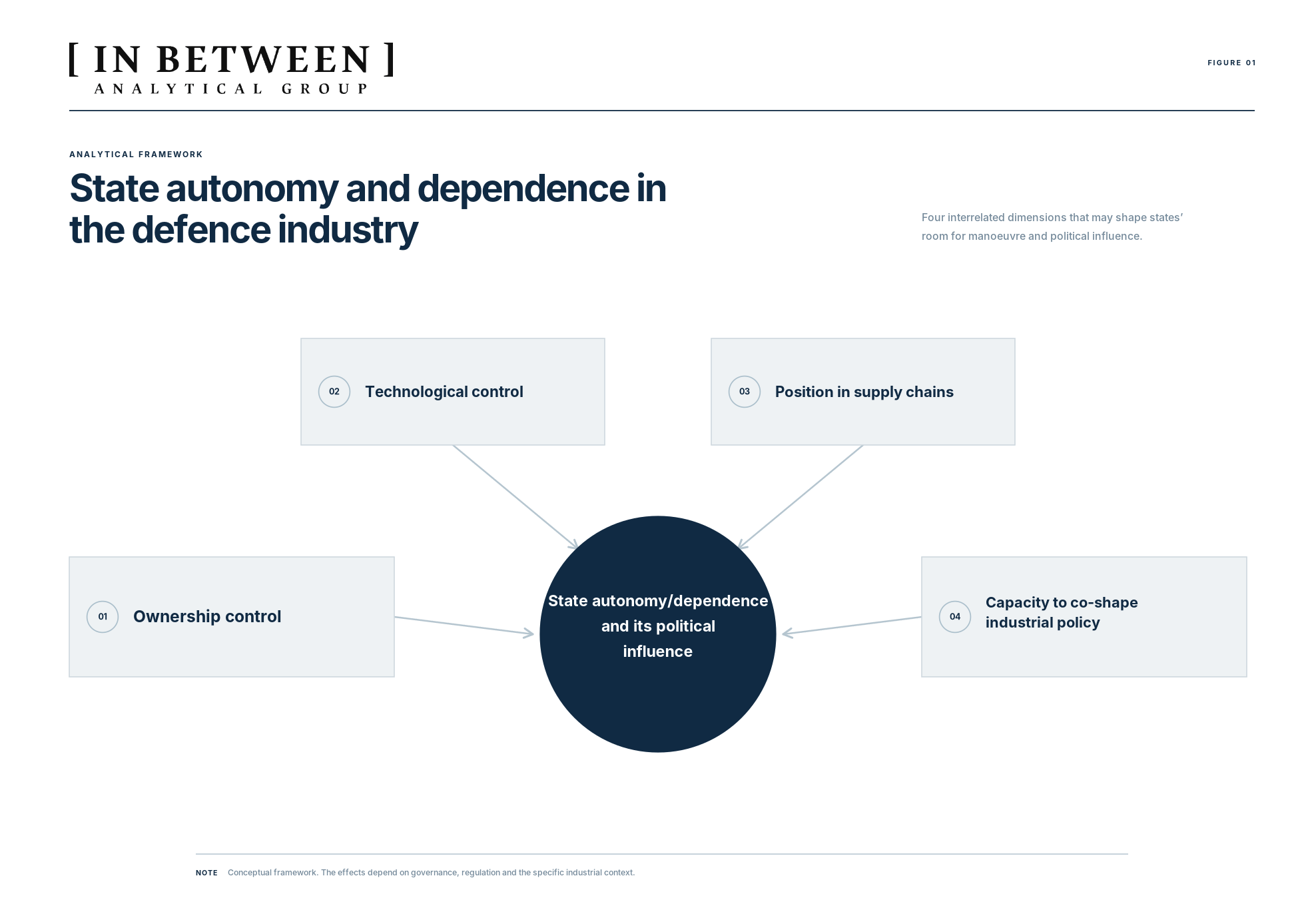
This does not mean that every foreign investor poses a threat. Political risk arises when a state becomes dependent on an entity whose strategic decisions lie beyond its control. In the defense sector, this dependency matters more as the product’s strategic importance increases. The second dimension is technological control. The ability to manufacture a particular weapons system does not necessarily imply the ability to develop, upgrade, and maintain it independently. A state may possess a factory, a workforce, and production lines while remaining dependent on a foreign technology owner for key components, software, upgrades, or further product development. Therefore, it is not enough to establish where a production facility is located. One must also determine where control over the company’s most strategic functions resides.
This leads to the third dimension: a company’s position in the value chain. A company may be a component supplier, a subcontractor, a producer of complete systems, a systems integrator, or the owner of a critical technology. Each position entails a different capacity to exert influence. The higher a company sits in the value chain, the more important it can be for national security.
In this sense, two types of dependency can be distinguished. The first is production dependency: a state needs a particular company because, without it, the state cannot produce the required quantity of armaments. The second is strategic dependency: a state needs a company because, without it, the state does not control the technology, systems integration, modernization, or another critical capability.
From a political-risk perspective, the latter matters far more.
The fourth dimension is public procurement policy. The state does not merely purchase armaments; through its procurement decisions, it also helps shape the industry’s structure. Selecting a particular supplier may support the development of a company, its technology, and its supply chain, while excluding another company may constrain its ability to grow. Defense procurement consequently becomes an instrument of industrial policy. This means political risk can operate in both directions. On the one hand, political decisions affect companies. On the other hand, companies that achieve a strong position in the defense sector begin to influence political decision-making. In strategic defense programs, the state may become dependent on maintaining particular production capacities, jobs, or technological competencies.
This raises questions about the industry’s political power.
The fifth dimension is concentration within the defense industry. European integration in the sector may lead to larger companies, joint programs, and more concentrated supply chains. From an economic perspective, this can improve efficiency and enable projects that individual states cannot finance on their own. From a political-risk perspective, however, the question is whether concentration also creates new dependencies.
The mechanism may be represented as follows:
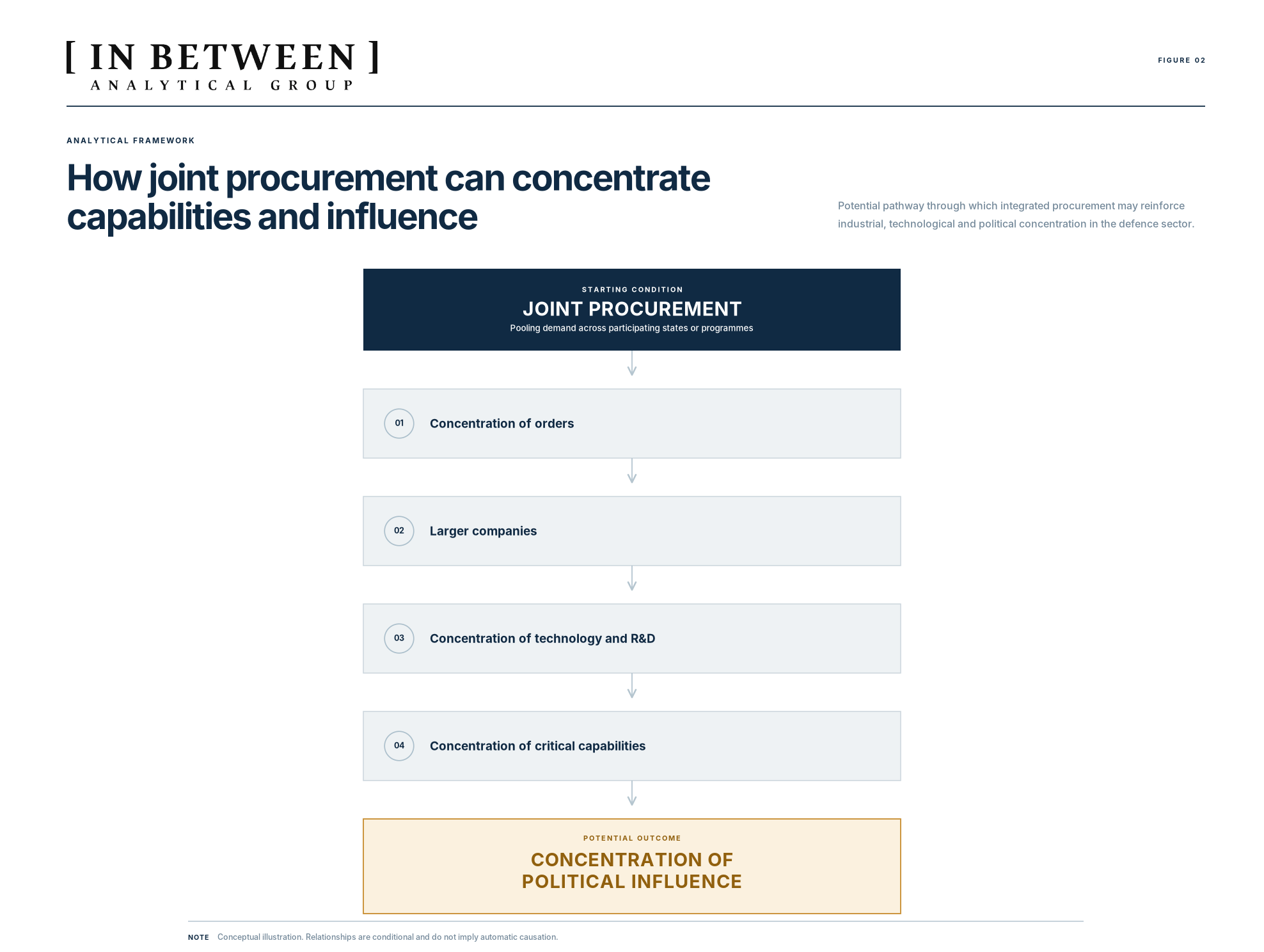
This is precisely where the paradox of European strategic autonomy emerges. Europe may reduce its dependence on suppliers outside the continent, while individual European states may become more dependent on a small number of companies and industrial centers in other EU member states.
This is particularly important for Central and Eastern European countries. Growing domestic defense industries can strengthen national resilience, but only if increased production is matched by greater control over technology, ownership, and critical parts of the value chain. Data on Europe’s defense sector indicate that the expansion of CEE companies has not yet transformed the market’s underlying structure. CSG and PGZ have grown in importance, but they remain considerably smaller than the largest Western European groups. At the same time, the most advanced technological competencies, research and development, and the integration of major programs remain concentrated in the core countries.
Political risk in the European defense industry should therefore not be defined solely by the risk of war, sanctions, or a change of government. It also includes risks stemming from the asymmetric distribution of ownership, technology, production capacity, and political influence. This perspective raises five fundamental questions:
Who owns the company?
Who controls the key technology and R&D?
What position does the company occupy in the European value chain?
Who makes decisions on procurement and the future development of capabilities?
Is the company dependent on the state, or is the state becoming dependent on the company?
The final question is particularly important. In conventional analysis, a company is primarily an actor exposed to political decisions. In the defense sector, however, this relationship may be reversed. A company with unique technology, strategic production capacity, or critical expertise may itself become a source of state dependence. Political risk then consists not only of politics affecting industry but also of industry structure constraining what the state can do politically.
This shifts the analysis of Europe’s defense industry beyond conventional industrial policy into political and strategic security.
Persistent asymmetries
The current phase of development in the European defense industry does not simply overcome the center–periphery divide. Rather, the data suggest a process of selective convergence: some companies from peripheral states are becoming more important thanks to exceptional international circumstances, but this does not fundamentally change the structure of ownership, technological control, or the location of the most advanced production functions. Central and Eastern European states are increasing production, employment, and the importance of their companies, yet this growth does not necessarily translate into a proportionate increase in control over technology, ownership, and the most strategic functions of the value chain. Decision-making centers, research and development, and the ability to coordinate the largest defense programs remain concentrated primarily in Western European countries. This may also reproduce existing economic asymmetries in the security sector.
As a result, Europe’s strategic autonomy may have a paradoxical effect: reducing the continent’s dependence on external suppliers while reinforcing asymmetric dependencies within Europe. This asymmetry should be recognized as an emerging source of political risk.
Jan Muś, analyst at In Between Analytical Group.
Discussion about this post