[Expert Dialogue] Why attributing Russia's hybrid attacks is not enough
A conversation with David Cattler

David Cattler, NATO’s former Assistant Secretary General for Intelligence and Security, discusses the limits of hybrid deterrence, intelligence cooperation among Allies, and why public attribution must be followed by credible consequences.
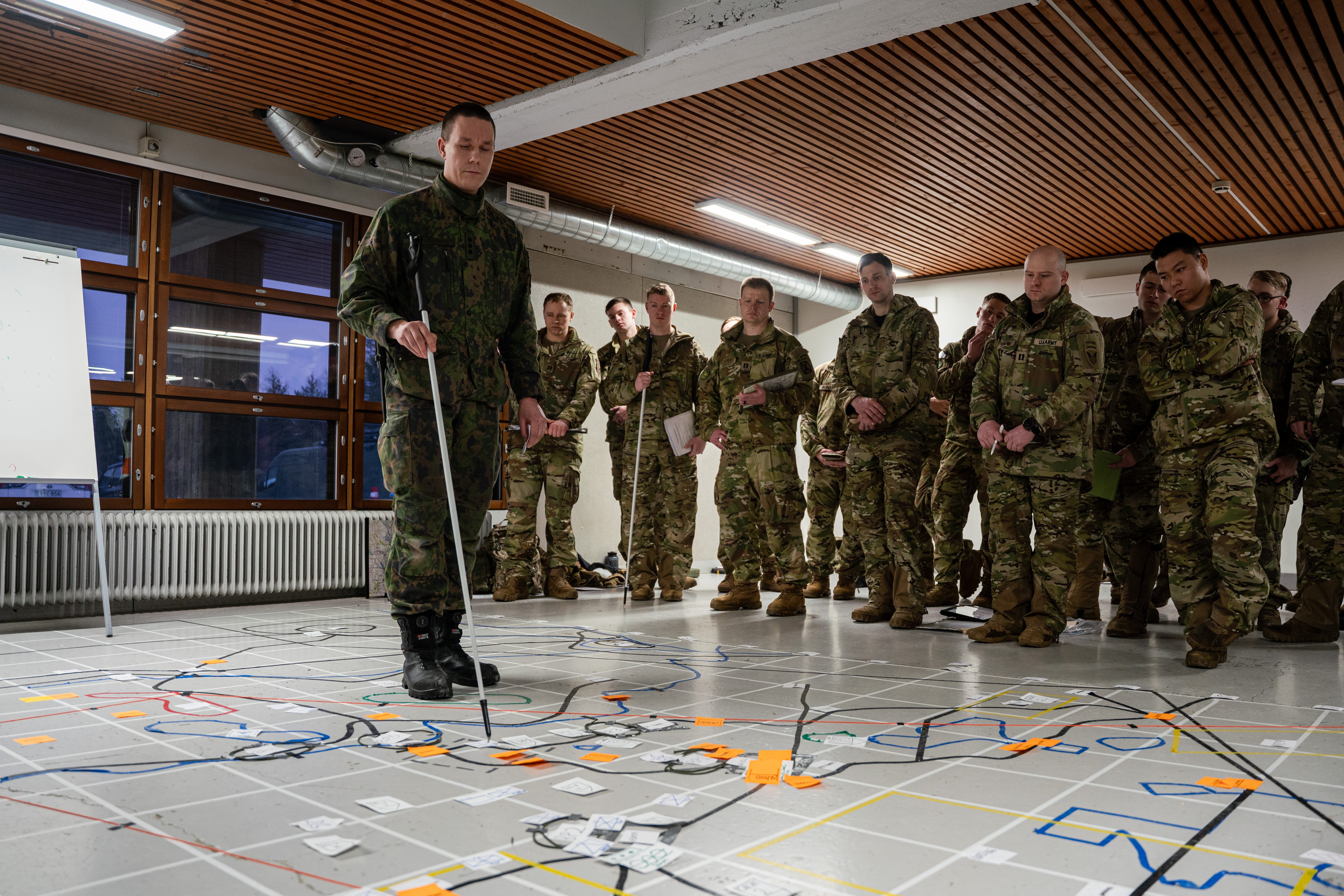
A Finnish officer briefs Finnish, Canadian and U.S. military personnel during Exercise Arctic Forge 2025 in Sodankylä, Finland, on February 23, 2025. Photo: U.S. Army / Sgt. Salvador Castro, via DVIDS (Public Domain).
Maciej Makulski: There is a growing debate about whether the concept of hybrid threats remains adequate to describe the current security environment. Some of this criticism comes from the Baltic states, where there have been calls to characterize certain Russian activities as state-sponsored terrorism rather than hybrid warfare. How relevant and useful is the concept of hybrid threats today?
David Cattler: I think it was important for NATO and individual Allies to define the concept some years ago because hybrid warfare is clearly different from conventional war. But the challenge now is that the threat has outpaced our politics, our laws, and, in many respects, the public’s understanding of what it is and how to address it. Consider GPS jamming near an airport. Most people first think of a delayed flight. But what if the interference affects an aircraft’s navigation and contributes to an accident? What if people are injured or killed? The consequences of these activities can be far more serious than the inconvenience we initially associate with them.
Interruptions to critical infrastructure, assassination, sabotage- we have seen all of these things in recent years. So I think, for instance, the three Baltic states especially have been leading in this area, as you said, just to ask this question, which is both political and judicial: well, is it terrorism? Is it state-sponsored terrorism? Is it war? The label matters, but what matters more is what we are prepared to do about the behavior. Clearly, deterrence in this area is not working nearly as well as deterrence against conventional military attack. There have been no conventional attacks on a NATO ally, certainly not since 2022, when Russia expanded its illegal war against Ukraine.
Yet, we have seen an increase in the pace and the geographic scope of hybrid attacks. Ultimately, these are political and legal decisions. If Allies want NATO to adopt a common definition and agree on the consequences, all 32 will need to reach consensus. NATO leaders have already agreed that, in certain circumstances, a hybrid attack could lead to invoking Article 5. The important question is how Allies understand the threat, assess a particular attack, and decide what response is warranted. But I would emphasize one hard fact. If Moscow sees that we struggle to determine what happened, identify who was responsible, and reach political agreement on how to respond, it will exploit that uncertainty. Public attribution is important. Germany’s willingness to identify an attack not simply as an isolated incident but as part of a Russian-directed campaign represents a significant political step. But attribution alone is not deterrence. The consequences that follow are what will shape Moscow’s calculations. If Russia sees that it can conduct these attacks, be publicly identified as responsible, and still face little or no meaningful consequence, we may actually encourage the very behavior we are trying to stop.
So Russia continues to test our responses, adjusting its subsequent actions depending on how we react. Is that essentially the logic behind these activities?
From Moscow’s perspective, these attacks need to be consequential enough to matter, but not so consequential that they provoke a conventional military response. They also need to preserve enough uncertainty about responsibility to complicate our political decisions. So again, the central challenge then for NATO, for the individual NATO states, is to pierce that uncertainty by information exchange, by communication, to be very clear about what’s happened, who’s done it, and what the consequences will be as a result.
Given your extensive experience in intelligence coordination, both in the United States and at NATO, how do you assess the Alliance’s ability to deter Russia today? Has closer intelligence cooperation made NATO’s response more effective and its deterrence posture more credible?
I’ll be careful not to talk about anything that’s inside the system, because a lot of that needs to stay protected. But I think the political statements have been quite clear over the past several years, certainly, but even more so since 2022, to both enable deterrence and to demonstrate proper readiness to defend. And I think that has yielded a key strategic result, because again, Russia has not conventionally attacked a NATO member state. I think NATO’s preparations, exercises, forward presence, and demonstrated readiness have made an important contribution to deterring a conventional Russian attack against an Ally. That is a significant strategic achievement, particularly since Russia expanded its war against Ukraine in 2022. I just saw in recent days great highlights of the NATO presence in Latvia, their readiness, the exercises that they conduct, and their integration with the Latvian military. These are all things that matter a great deal, and you benefit when you come here.
You can see yourself and talk to people about it. Across 32 allies, NATO has more than 80 intelligence and security services. And I would say often, when I was the lead for intelligence and security for the alliance, that that’s something that we should be talking about more frequently, because that is yet another key strategic strength of the alliance. When you have 80 intelligence services working together, what question can’t they answer? What problem can’t they explain? And I think the proof of that is the consistency in the strategic political messaging and in the military readiness and the capabilities that NATO displays. When you get into hybrid, though, the challenge is quite a bit different, because the problem is often within the nation, within an individual NATO member, and correspondingly, it’s much, much more sensitive. Is that something that the capital wishes to make an alliance issue? Do they really wish to bring it in? To have 31 other nations debate what happened and what we see? How should we think about it, and what should we do? Increasingly, though, I think Allies need to bring these issues to NATO because Moscow is conducting a campaign, not simply a series of unrelated attacks. An incident in one country may look isolated until you compare it with similar incidents elsewhere. That broader pattern becomes much clearer when intelligence is shared, and the activity is examined collectively. But national governments must be willing to share the information and have the political discussion about what it means and how to respond.
This brings us to the question of coordination. In recent weeks, there has been considerable debate about the possibility of a Russian attack against a NATO member state, with Estonia frequently mentioned as a potential target. At the same time, Baltic officials have indicated that their intelligence does not point to preparations for such an attack. Do these seemingly divergent messages suggest a lack of coordination among Allies, even if that sounds too strong? Should NATO members be speaking with a more unified voice on such threats?
But now… I agree that describing this as a failure of coordination is too strong. Both things can be true. A Russian attack against a Baltic state is plausible, given the geography and the nature of the threat. But that does not mean an attack is imminent or that the intelligence currently indicates Russia is preparing to conduct one. We need to distinguish capability, intent, and readiness.
To be clear, the Baltic states are not ruling out the possibility of such an attack.
Of course. Right. So you have to be aware of the capability, the intent, and the readiness. Those things together will give you a better appreciation of the probability, the likelihood that something like that can happen. When my Baltic colleagues say that an attack is plausible but they do not see Russia preparing to conduct one, that does not mean they are complacent—quite the opposite. Estonia, Latvia, and Lithuania have invested considerable effort in understanding the threat, improving their readiness, and preparing for contingencies. They have better prepared themselves. They have increased their intelligence capabilities, especially those that could be used to monitor for Russian readiness to conduct such an attack. Their military is more capable and ready. They’ve acquired new systems. They’ve trained differently. And they have invited an increased NATO presence, and the presence of others. And here I say “other”: many of the same nations, just through different political and alliance structures. Nonetheless, there has been more air policing, for example, and better air-defense readiness. You have greater land readiness across the Baltic region because politicians have led from the front. For example, Kaja Kallas, currently the EU’s High Representative for Foreign Affairs and Security Policy, famously said there will be no Bucha in Estonia. That was a powerful statement, and an enduring challenge to Estonia’s national security institutions, the Baltic states, and NATO. They cannot afford to be surprised. Their populations should not suffer because their governments failed to prepare for a threat they could see developing. And that’s, again, why I say you see them having taken these steps. Russia should not have a veto over how NATO members organize their defense or prepare to protect their populations. The Allies have an inherent right to defend themselves. They are exercising that right by improving their military capabilities, strengthening societal resilience, and making clear that they are prepared to respond to aggression. That is not provocation. It is deterrence. The objective is to convince Moscow that an attack would be a strategic mistake and to prevent it from happening in the first place.
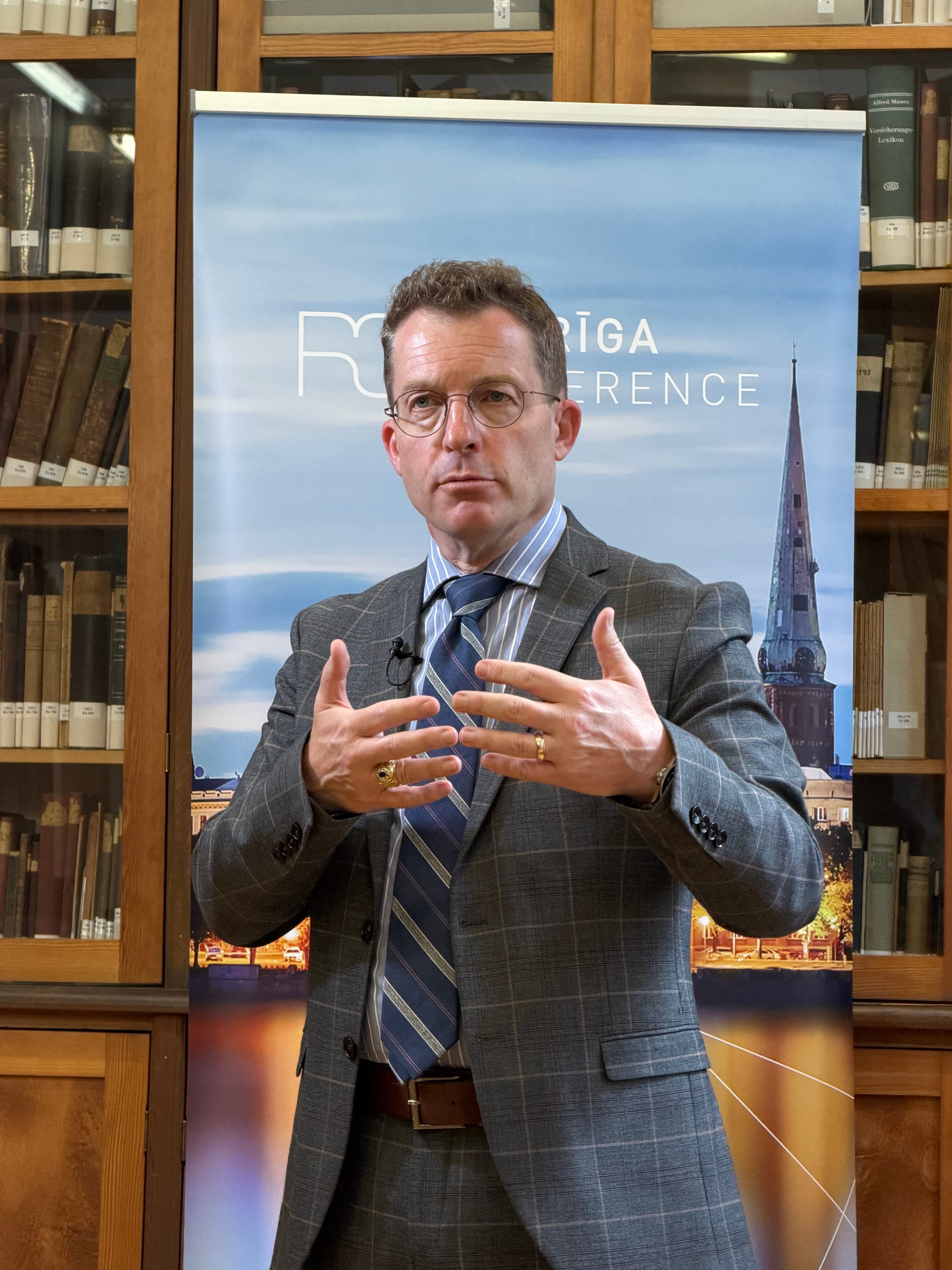
Photo courtesy of David Cattler.
This also brings us to NATO’s strategic communication. Political statements are one way to communicate the Alliance’s resolve, but military deployments, exercises, and coordination among Allies also send important strategic signals. These actions demonstrate not only NATO’s willingness to defend itself but also its growing capabilities.
Another thing to highlight about Latvia and Riga in particular: Riga is home to the NATO Center of Excellence for Strategic Communication. The EU also invests in that same center of excellence. Their conference was held in June, and I was there; it also convenes a great number of experts, not just in strategic communication, but in intelligence, diplomacy, and military capabilities from across the alliance. Many Ukrainians at that conference also shared their lessons learned. Words matter, but real capabilities and demonstrable readiness must support them. NATO needs to communicate clearly with its own populations, with its Allies, and with potential adversaries. If our statements and our actions do not match, we risk creating precisely the misunderstanding we are trying to avoid. Declaring that we are ready when we demonstrably are not could invite aggression. Equally, careless language about military action could create unnecessary risks of escalation. Credible deterrence requires that our words and actions reinforce one another.
At the Warsaw Security Forum, General Alexus Grynkewich presented NATO’s Theory of Victory, describing how the Alliance would block, blunt, and, if necessary, break an attack against its territory. In your view, is this the kind of clear, firm strategic messaging NATO needs to deter Russia? And how can the Alliance ensure Moscow sees such messages as credible deterrence rather than escalatory rhetoric?
Yes, I think this is the kind of clarity NATO needs. A credible deterrent requires an adversary to understand not only that the Alliance is willing to defend its territory, but that it has the capability and the plans to do so effectively. The distinction between blocking, blunting, and breaking an attack is useful because it communicates that NATO is preparing for different stages of a potential conflict, not simply relying on a political declaration of resolve. But credibility ultimately depends on what Moscow can observe. Are Allied forces ready? Are the necessary capabilities in place? Can the Alliance reinforce and sustain its defenses? Are political leaders prepared to make difficult decisions? I would not regard clear statements of defensive intent as inherently escalatory. The greater danger is a gap between what NATO says it will do and what it is demonstrably prepared to do. That is where deterrence can fail.
Returning to the question of terminology, is NATO’s main challenge not so much finding the right label for these activities, but developing a shared understanding of the threat that enables Allies to reach political consensus and take meaningful action?
I think the central point is that we need a shared understanding of what we are seeing and what it means. Whether we call it hybrid warfare, state-sponsored terrorism, or something else, the terminology must be clear enough to support political agreement and practical action. Definitions matter because they can determine which legal authorities are available, which institutions are responsible, and what responses governments are prepared to undertake. But if we describe an attack as terrorism or even an act of war, and then fail to attach meaningful consequences, our words lose their force. Moscow understands clarity, firmness, and strength. When it perceives confusion or weakness, it is more likely to press its advantage. Leaders in the Baltic states and elsewhere in Eastern Europe understand that particularly well, having experienced Russian aggression and interference over many years. NATO’s challenge is to recognize these activities as part of a broader campaign, build the political consensus to respond, and then act. Public attribution is important, but it is not enough. Without credible consequences, we are unlikely to achieve the deterrence we need.
So the real test is whether our words are backed by action.
Right. And what does Moscow understand the most? They understand clarity and firmness. They understand strength. When they perceive confusion and weakness, they tend to press forward. I think many leaders, especially in Central and Eastern Europe and in the Baltics, know that all too well. And that’s why it’s so important for them to continue to speak, to play a leading role in the debate, and to try to keep the focus on what’s happening. Because yes, while it’s the case that there have been hybrid attacks across Europe, there have also been many, many more of them, I think, fair to say, in the east of Europe. Yes. Whether in the Baltic region, Poland, Romania, Bulgaria, the Czech Republic, or Slovakia, they have all seen these attacks over time. And again, I don’t mean to minimize; we’ve also had assassinations and assassination attempts in the UK, and attacks in Spain. So it’s becoming increasingly important that the Alliance grasp this and develop modern terminology. But without sufficient consequences, I don’t think we’ll achieve the deterrence the Alliance needs.
—
David Cattler is the founder and Managing Principal of Ironhelm Works, a strategic advisory firm focused on security, defense, and transatlantic affairs. He served as NATO’s Assistant Secretary General for Intelligence and Security from 2019 to 2023 and as Director of the U.S. Defense Counterintelligence and Security Agency from 2024 to 2025. His earlier senior positions included assignments at the White House National Security Council, the Office of the Director of National Intelligence, and the Joint Staff. He is a Non-Resident Fellow at the International Centre for Defence and Security in Tallinn.
Maciej Makulski is the Project Lead at In Between Analytical Group.
—
The interview was conducted during the Riga Conference 2026. One follow-up question was answered by email after the conference.
The appearance of U.S. Department of War (DoW) visual information does not imply or constitute DoW endorsement.
Discussion about this post