


On October 3, Latvia held elections to the 15th Saeima. The Prime Minister Andris Kulbergs’ United List (AS) emerged as the clear winner: 35.3% of the vote and 41 of the 100 seats in parliament. AS therefore fell ten seats short of an outright majority and will need at least one coalition partner.
Coalition talks are only beginning. United List has indicated that it would first approach its current coalition partners, National Alliance (NA) and New Unity (JV). Kulbergs has ruled out cooperation with Latvia First (LPV), while both AS and other parliamentary parties have also expressed reluctance to work with Sovereign Power / Young Latvians (SV/AJ). A coalition with NA, JV, or both therefore appears among the most straightforward options, although the final configuration remains open.
Note: The table includes parties that won seats in 2022 and in 2026. It does not show all 14 lists contesting the 2026 election. Sovereign Power / Young Latvians is shown without a 2022 comparison because the 2026 alliance is not directly comparable with a single list from the previous election.
The winners and the losers
United List emerged as the clear winner, taking 35.3% of the vote and 41 seats. However, it will still need at least one coalition partner to govern.
It is the largest parliamentary representation won by a single electoral list in Latvia since the restoration of parliamentary elections in 1993. In the first post-restoration election that year, Latvia’s Way won 36 seats with 32.4% of the vote. AS has therefore surpassed that record as well as the largest winning vote share in this period. AS also achieved the largest-ever lead in seats over the next party (24 seats).
Following the results, PM Kulbergs described the result as a signal that voters wanted change. That message will now shape expectations surrounding the formation of the next government.
The clearest loser was New Unity (JV), which had won the 2022 election with 19.2% of the vote and 26 seats. This time it received 6.4% and only seven seats, down almost 13 percentage points and 19 mandates.
The Union of Greens and Farmers (ZZS) also suffered a major defeat. Four years ago it won 12.6% of the vote and 16 seats; in 2026 it received just 4.4% and failed to clear the nationwide 5% threshold. For the first time in the alliance’s 24-year history, ZZS will not be represented in the Saeima.
The Progressives: more votes, same number of seats
The Progressives were part of Evika Siliņa’s governing coalition until May 2026, when they withdrew their support during the political crisis that eventually brought her government down. They were not part of the Kulbergs government formed later that month.
In the election, the Progressives increased their vote share from 6.2% in 2022 to 7.9% in 2026, yet they will hold exactly the same number of seats: ten.
This discrepancy stems from Latvia’s electoral system. The country is divided into five multi-member constituencies - Rīga, Vidzeme, Latgale, Kurzeme and Zemgale - which together elect 100 MPs. Lists receiving less than 5% of the nationwide threshold are excluded from seat allocation.
Seats are then distributed separately within each constituency. The number of votes won by each eligible list is divided successively by 1, 3, 5, 7 and so on, with mandates assigned according to the highest resulting quotients - a version of the Sainte-Laguë method. This means that changes in nationwide vote share do not translate mechanically into changes in the number of seats. The geographical distribution of support across the five constituencies also matters.
Latvian voters can also cast a preferential vote by supporting individual candidates or crossing out those they oppose. Preferential voting therefore affects the final order of candidates on each list.
Record-low turnout: a warning sign for Latvia’s political class?
Perhaps the most troubling result was not any particular party’s performance, but the low voter turnout.
Turnout fell to 51.8%, compared with 59.4% in 2022 - a decline of 7.6 percentage points. It was the lowest turnout recorded in a Saeima election since parliamentary elections were restored in 1993.
The longer-term pattern is also notable. Turnout exceeded 70% in the parliamentary elections of the 1990s and early 2000s, fell to 61% in 2006, and has remained below that level ever since, with the partial exception of the rebound recorded in 2022.
Therefore, paradoxically, United List enters the new Saeima with the strongest parliamentary position achieved by a single list since 1993, yet it does so after an election defined by historically low participation. The government will therefore combine an unusually strong parliamentary mandate with much weaker electoral mobilization.
—
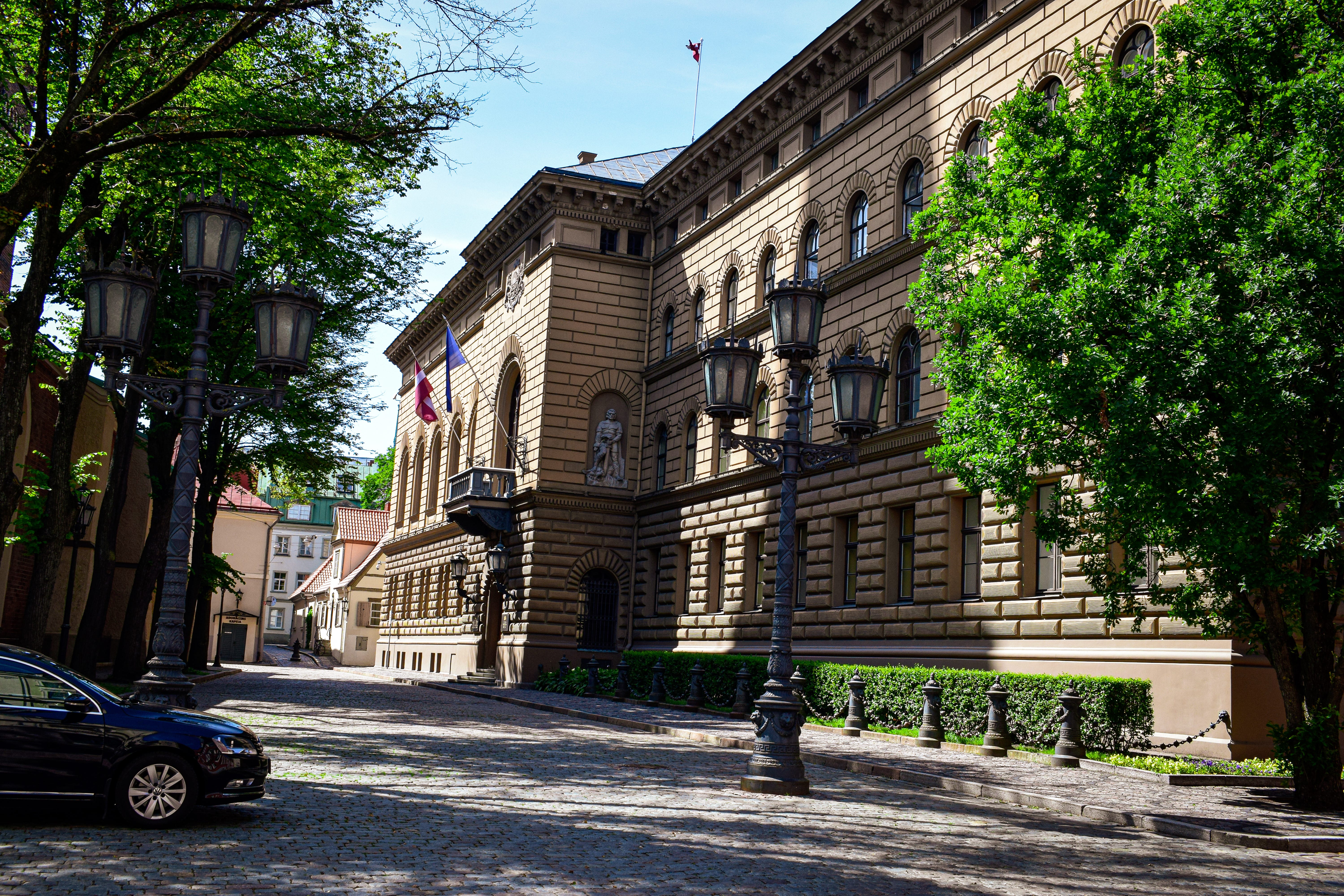
Photo: The Saeima building in Riga. Photo: PROP1001 / Wikimedia Commons, CC BY-SA 4.0.

